
Menopause brings changes to your body, including joint discomfort that can affect your daily movement. But with the right insights and strategies, you can protect your flexibility, maintain your strength, and stay active through this transition and beyond.
In this article, you’ll learn why menopause and joint pain happen, how they affect your joints and bones, and practical strategies to reduce discomfort while protecting your long-term flexibility.
Disclaimer: This assessment is for informational purposes only and does not replace medical care.
What Is Menopause?
Menopause marks the end of your menstrual cycles, confirmed after you’ve gone 12 months without a period. Most women reach menopause between ages 45 and 55, with the average age being 52.
But the transition starts years earlier during perimenopause, when your hormone levels begin to fluctuate and drop. This phase can last 4-10 years before your periods stop completely.
4 Main Causes of Joint Pain During Perimenopause and Menopause
The connection between menopause and joint pain involves multiple body systems, not just one simple cause.
- The Hormonal Role of Estrogen
Estrogen receptors exist throughout your musculoskeletal system, including in joint cartilage, bone tissue, and the fluid that lubricates your joints.
When estrogen drops, several things happen:
- Cartilage breaks down faster than your body can repair it
- Joint fluid becomes less effective at reducing pressure between bones
- Inflammatory chemicals increase in joint spaces
- Pain sensitivity goes up throughout your nervous system
When estrogen levels drop during menopause, your joints become more vulnerable to inflammation, wear, and pain. Women notice joint pain most often in their knees, hips, hands, shoulders, and neck.
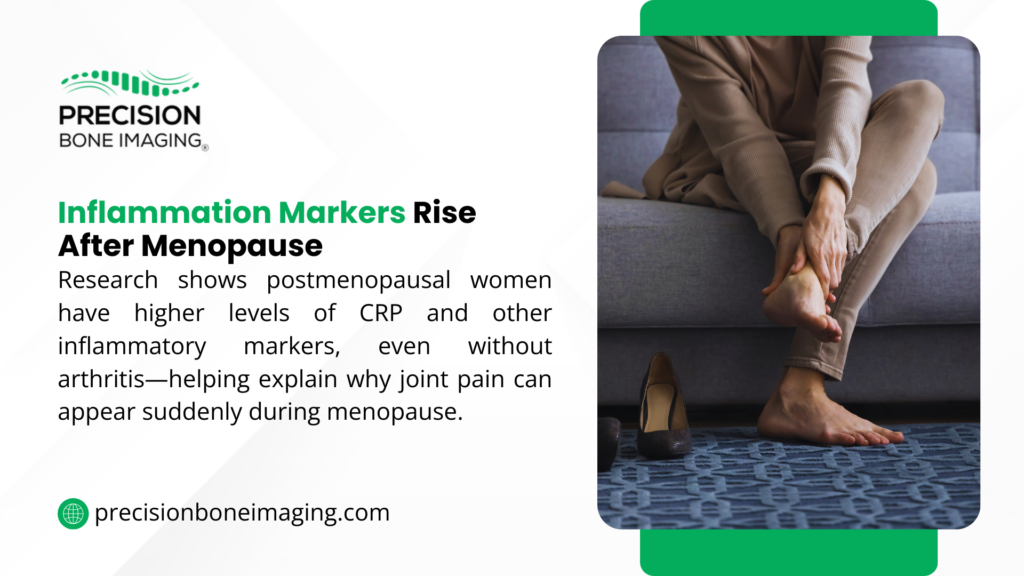
Research shows that estrogen has anti-inflammatory properties that help control joint swelling and discomfort. As these hormone levels decline, inflammatory markers in your body increase.
This explains why menopause and joint pain often appear together, even in women who never had joint problems before.
- Bone Density Changes and Joint Stress
Your bones and joints work as a connected system. When bone density drops during menopause, the framework supporting your joints weakens.
Lower bone density means:
- Joints must absorb more impact during daily activities
- Cartilage experiences increased stress and wear
- Risk of osteoporosis rises, which further affects joint health
Many women don’t realize their joint pain connects to underlying bone changes. Learn more about how to prevent osteoporosis to protect both bones and joints.
- Muscle and Connective Tissue Changes
Estrogen loss also affects muscles and the connective tissue that holds joints together. After menopause, women lose muscle mass faster through a process called sarcopenia.
Weaker muscles mean:
- Less support and stability for your joints
- Joints work harder during normal movement
- Higher injury risk from everyday activities
- More strain on cartilage and ligaments
Connective tissue also loses elasticity and becomes stiffer, which adds to the sensation of joint pain during menopause.
- Weight Gain and Joint Load
Many women gain weight during menopause due to hormonal changes, slower metabolism, and reduced activity levels. Every extra pound adds approximately four pounds of pressure on your knees.
| Weight Factor | Impact on Joints |
| 5 pounds gained | 20 pounds extra pressure on knees |
| 10 pounds gained | 40 pounds extra pressure on knees |
| 15 pounds gained | 60 pounds extra pressure on knees |
This additional load accelerates cartilage wear and increases pain, especially in weight-bearing joints like knees, hips, and ankles.
Common Symptoms and How Menopause Joint Pain Actually Feels
The experience of menopause and joint pain varies from woman to woman, but certain patterns show up consistently.
| Symptom | What Women Commonly Experience |
| Morning stiffness | Joints feel locked or stiff when waking up, often taking 30 minutes or more to loosen as you start moving. |
| Intermittent pain | Joint pain that comes and goes. You may feel fine for days, then suddenly wake up with aching joints for no clear reason. |
| Migrating joint pain | Pain that moves between joints, such as knees one week and hands or shoulders the next. |
| Swelling and warmth | Mild swelling or warmth in affected joints, sometimes noticed as puffiness in fingers. |
| Reduced range of motion | Gradual loss of flexibility, making everyday tasks like opening jars, squatting, or reaching overhead more difficult or uncomfortable. |
| Pain with movement and rest | Joint pain that worsens with activity but also aches during prolonged rest, creating a frustrating cycle where neither moving nor resting brings full relief. |
These symptoms typically begin in perimenopause and may improve after your body adjusts to lower hormone levels, though this isn’t guaranteed.
What Isn’t Menopause — Other Possible Causes to Consider
Not all joint pain during midlife comes from hormonal changes. Other conditions can develop at the same age and cause similar symptoms.
- Osteoarthritis
This wear-and-tear arthritis results from cartilage breakdown over time. Menopause can accelerate osteoarthritis, but the condition can also develop independently of hormonal changes.
Osteoarthritis typically affects specific joints consistently rather than moving around, and X-rays show characteristic changes in joint structure.
- Rheumatoid Arthritis
This autoimmune disease causes your immune system to attack joint tissue. Unlike hormonal joint pain, rheumatoid arthritis usually affects the same joints on both sides of your body symmetrically.
Blood tests can detect inflammatory markers and antibodies specific to rheumatoid arthritis.
- Fibromyalgia
This condition causes widespread pain, fatigue, and tender points throughout your body. While fibromyalgia can coexist with menopause and joint pain, it involves more than just joint discomfort.
- Previous Injuries
Old injuries to joints, ligaments, or bones can become more painful during menopause as estrogen’s anti-inflammatory effects disappear.
- Thyroid Problems
Thyroid disorders become more common during midlife and can cause joint pain, muscle aches, and fatigue that mimic menopausal symptoms.
| Condition | Key Differences from Menopause Joint Pain |
| Osteoarthritis | Consistent location, visible on X-rays, bone spurs may develop |
| Rheumatoid Arthritis | Symmetrical pattern, positive blood tests, more severe morning stiffness |
| Fibromyalgia | Widespread body pain, extreme fatigue, tender points |
| Thyroid Disease | Additional symptoms like weight changes, temperature sensitivity |
If your joint pain is severe, affects your daily function, or doesn’t improve with basic self-care strategies, consider discussing additional assessments with your healthcare provider.
The genetic component of bone health can also play a role in how menopause affects your joints.

Practical and Evidence-Based Ways to Manage Joint Pain
You don’t have to accept joint pain as an unavoidable part of menopause. Several approaches can provide real relief.
Strategy | Why It Helps Joint Pain During Menopause |
Low-impact exercise | Protects joints while maintaining strength and flexibility. Activities like swimming, cycling, and walking help reduce joint pain and stiffness. |
Regular movement goals | It’s recommended at least 150 minutes of moderate activity per week, broken into manageable sessions to reduce stiffness and pain. |
Strength training | Builds muscle that supports and stabilizes joints. Light dumbbells, resistance bands, or bodyweight exercises are effective, without requiring heavy weights. |
Targeted muscle focus | Strengthening muscles around the hips, knees, and core helps offload pressure from joints, improving stability and reducing pain. |
Anti-inflammatory diet | Emphasize fatty fish (omega-3s), colorful fruits and vegetables, nuts, seeds, olive oil, and whole grains. |
Foods to limit | Processed foods, excess sugar, and red meat may increase inflammation and worsen joint discomfort. |
Hydration | Aim for 8–10 glasses of water daily, increasing intake with activity or hot climates. |
Quality sleep | Supports tissue repair and inflammation control. Poor sleep increases pain sensitivity and can worsen joint discomfort. |
4 Main Supplements That May Help Relieve Joint Pain
| Supplement | Potential Benefits for Joint Health |
| Glucosamine & Chondroitin | May help support or rebuild cartilage in some people. Research shows mixed results, but many women report reduced joint pain and stiffness. |
| Omega-3 Fatty Acids (Fish Oil) | Have anti-inflammatory properties that can help ease joint pain and stiffness. |
| Vitamin D | Supports bone health and may help reduce inflammation. Deficiency is common in women, especially after menopause. |
| Calcium | Helps maintain bone density that supports healthy joints. Women over 50 generally need about 1,200 mg per day. |
Always check with your doctor before starting new supplements, especially if you take medications.
The Bone Health Connection You Must Not Ignore
Joint pain during menopause often signals changes happening in your bones as well. The same estrogen loss that affects joints also accelerates bone density loss.
Traditional bone density tests measure the amount of minerals in your bones, but that’s only part of the story. Bone quality refers to the internal structure and architecture that determines how well your bones resist fractures.
Two women can have identical bone density scores but very different fracture risks based on bone quality factors like:
- Microarchitecture and trabecular pattern
- Rate of bone turnover
- Accumulated microdamage
- Mineralization distribution
During menopause, both density and quality change, which affects how your joints function and overall fracture risk — an important consideration for anyone concerned about menopause and joint pain.
REMS vs DXA: Advanced Bone Monitoring for Menopause
When you’re experiencing menopause and joint pain, understanding what’s happening in your bones becomes crucial. Traditional bone density tests provide only part of the picture.
Why Bone Quality Matters During Menopause
Bone density measures the amount of minerals in your bones, while bone quality reflects the internal structure and architecture that affects fracture risk.
Two women can have identical bone density scores but completely different fracture risks based on quality factors:
- Microarchitecture and trabecular pattern: The internal scaffolding structure that gives bones strength
- Rate of bone turnover and remodeling: How quickly your body removes old bone and replaces it with new tissue
- Accumulated microdamage from stress: Small cracks and weaknesses that build up over time
- Mineralization distribution (sometimes called bone mineral distribution) refers to how evenly minerals like calcium and phosphate are deposited throughout the bone tissue.
During menopause, both density and quality change rapidly. Tracking both gives you the complete picture of how hormonal changes affect your skeletal health, information that’s especially valuable when you’re also dealing with joint pain.
REMS Technology: More Accurate Assessment for Menopausal Women
Advanced REMS (Radiofrequency Echographic Multi-Spectrometry) technology assesses both bone density and quality in a single, radiation-free scan.
Research shows REMS delivers up to 30% more accurate fracture risk prediction than DXA and 40% greater sensitivity to changes in bone quality.
REMS vs DXA Comparison for Menopause Monitoring:
| Feature | Traditional DXA Scan | Advanced REMS Technology |
| Fracture Risk Accuracy | Standard baseline | Up to 30% more accurate at DXA |
| Sensitivity to Bone Changes | Standard sensitivity | 40% greater sensitivity to changes in bone quality |
| Radiation Exposure | Low-dose X-rays | Zero radiation (ultrasound-based) |
| Scan Frequency Safety | Limited due to radiation | Safe for every 6-12 months |
| Scan Duration | 10-30 minutes | 5-10 minutes |
| Results Timeline | Days to weeks | Instant results |
| Affected by Arthritis | Yes, can skew results | No interference |
| Affected by Scoliosis | Yes, can skew results | No interference |
| Affected by Metal Implants | Yes, can skew results | No interference |
| What It Measures | Bone density only | Both density and quality |
Why REMS Matters Specifically for Menopausal Women
For women in menopause, this increased sensitivity matters significantly:
Faster feedback on your efforts
REMS detects bone changes from your interventions (diet, exercise, supplements, hormone replacement therapy) months earlier than traditional scans. This means you know sooner whether your prevention strategies are working.
Safe for frequent monitoring
No radiation exposure means you can track changes every 6-12 months throughout the menopause transition without accumulating radiation dose or health concerns.
Reliable results despite common conditions
Not affected by arthritis, scoliosis, or metal implants, which are common conditions in menopausal women that can interfere with traditional DXA accuracy.
Complete picture of bone response
Shows both density and quality changes, revealing exactly how your bones respond to falling estrogen levels and your bone protection efforts.
Quick and convenient
The scan takes 5-10 minutes with instant results, allowing you to see exactly how your bone health connects to your joint pain symptoms during the same appointment.
For more information on this technology, read our guide on DXA vs REMS radiation to understand the differences.
Take Control Of Your Bone and Joint Health Today!
Precision Bone Imaging offers advanced REMS screening that assesses both bone density and quality without radiation exposure. The technology provides instant results and detailed analysis to help you understand exactly what’s happening in your bones during menopause.
With over 2,400 women served, we’ve become a trusted resource for those seeking clear answers about their bone health during menopause and beyond. Book your radiation-free bone density scan today to take control of your menopause and joint pain, and get the complete picture of your skeletal health.

Frequently Asked Questions (FAQ) About Menopause and Joint Pain
Will my joint pain go away after menopause?
Some women experience improvement once their hormones stabilize after menopause, typically 2-3 years after periods stop completely. However, joint pain can persist if cartilage damage has occurred or if other factors like osteoarthritis are involved.
Is joint pain a normal part of menopause?
Joint pain affects up to 60% of women during menopause, making it very common though not inevitable. While it’s normal in the sense that many women experience it, you don’t have to accept pain as unavoidable.
What exercises are best for menopause joint pain?
Low-impact activities work best: swimming, water aerobics, cycling, elliptical machines, walking, and strength training 2-3 times per week with light weights or resistance bands.
How long does joint pain during menopause typically last?
Joint pain during menopause typically lasts several years, often starting in perimenopause and continuing through early postmenopause. The good news is that consistent exercise, weight management, and proper nutrition can reduce symptoms significantly regardless of how long you’ve had pain.
Important Note:
This article is made for educational purposes only and does not replace medical care. Always consult with your healthcare provider, especially if you have existing bone health concerns.