
Knowing what exercises increase bone density in the spine helps you make better fitness choices. This guide covers 12 evidence-based exercises that target spinal bone health, with detailed instructions for safe performance.
1. Deadlifts
Deadlifts rank among the most effective exercises that increase bone density in the spine because they load your entire posterior chain with significant resistance.
This compound movement creates compression forces through your vertebrae while you lift weight from the ground. The mechanical stress signals your body to build stronger bones, particularly in the lumbar spine and thoracic regions.
How to perform deadlifts:
- Stand with your feet hip-width apart, with a barbell or pair of dumbbells on the floor in front of you.
- Bend at your hips and knees to grip the weight, keeping your back straight and core engaged. Your shoulders should be slightly ahead of the bar.
- Take a deep breath, brace your core, and drive through your heels to stand up straight, keeping the weight close to your body.
- At the top, your hips and knees should be fully extended.
- Lower the weight with control, maintaining proper posture throughout the movement.
- Start with lighter weights to master the form, and gradually progress to heavier loads as your strength improves.
2. Weighted Squats
Squats load your spine vertically, creating compression that stimulates bone growth from your lumbar vertebrae through your thoracic spine.
The upright torso position during squats places your vertebrae in a stacked alignment, which distributes force evenly and promotes bone remodeling.
Research shows that moderate to heavy squats performed 2-3 times weekly can significantly improve lumbar spine bone density over six months.
How to perform weighted squats:
- Stand with your feet slightly wider than hip-width apart, toes pointing slightly outward.
- Hold dumbbells at your shoulders or rest a barbell across your upper back (not on your neck).
- Keep your chest up and your spine neutral.
- Lower yourself by bending your knees and hips simultaneously, as if sitting back into a chair.
- Go as deep as you can while maintaining a straight back, ideally until your thighs are parallel to the floor.
- Push through your heels to return to the starting position, squeezing your glutes at the top.
- Keep your knees aligned with your toes throughout the movement, and avoid letting them collapse inward.
3. Seated Row
The seated row strengthens the muscles that support your mid-back and thoracic spine while creating loading forces that benefit vertebral bone density.
This exercise targets your latissimus dorsi, rhomboids, and middle trapezius muscles, all of which attach to your vertebrae and create tension that stimulates bone growth.
Pulling movements like rows also help correct forward posture, which protects your spine from uneven force distribution.
How to perform seated rows:
- Sit on a rowing machine or bench with a resistance band anchored at chest height.
- Place your feet firmly on the footrests with a slight bend in your knees.
- Grab the handles with both hands, keeping your back straight and chest up.
- Pull the handles toward your ribcage, squeezing your shoulder blades together at the end of the movement.
- Your elbows should travel straight back, staying close to your sides.
- Hold for one second, then slowly extend your arms back to the starting position with control.
- Focus on the pulling motion coming from your back muscles, not just your arms.
4. Farmer’s Carry
Farmer’s carries load your spine with sustained compression while you walk, forcing your core and back muscles to stabilize your vertebrae under load.
This exercise improves grip strength, which research links to better bone density in older adults. The upright walking position engages your erector spinae muscles along the length of your spine, creating the mechanical stress that builds bone.
How to perform farmer’s carries:
- Hold a heavy dumbbell or kettlebell in each hand, letting your arms hang naturally at your sides. Stand tall with your chest up, shoulders back, and core engaged.
- Walk forward in a slow, controlled manner for 30-60 seconds or 20-40 steps.
- Maintain perfect posture throughout the walk, avoiding any leaning or slouching.
- Your spine should stay neutral, and your shoulder blades should be pulled back and down.
- If you feel your form breaking down, put the weights down and rest before continuing.
5. Standing Posture Alignment
Proper posture alignment creates the foundation for all other exercises that increase bone density in the spine, and it helps distribute forces evenly across your vertebrae during daily activities.
This exercise teaches you to engage the muscles that support your spine while maintaining optimal alignment. Good posture reduces the risk of compression fractures by preventing excessive forward bending that loads the front of your vertebrae.
How to perform standing alignment:
- Stand with your feet about hip-width apart.
- You can use a wall initially for feedback by standing with your back against it.
- Imagine a string pulling you up from the top of your head, lengthening your spine.
- Gently pull your shoulder blades together and down, away from your ears.
- Engage your core by drawing your belly button slightly toward your spine.
- Tuck your chin slightly so your ears align over your shoulders.
- Push the floor away with your feet as you imagine yourself growing taller and avoid arching your lower back excessively.
- Hold this aligned position for 30-60 seconds, breathing normally.
- Practice this alignment several times throughout the day until it becomes natural.

6. Bird Dog
The bird dog exercise strengthens your entire posterior chain while maintaining a neutral spine position, which makes it one of the safest options for people concerned about spine health.
Research shows that bird dog exercises create 3,000 Newtons of compression on the spine, about half the force of back extensions, but still providing significant strengthening benefits.
This exercise engages your multifidus and erector spinae muscles, which run the length of your spine and provide critical stability.
How to perform bird dog:
- Start on your hands and knees in a tabletop position, with your hands directly under your shoulders and knees under your hips.
- Keep your spine in a neutral position by engaging your core muscles.
- Simultaneously raise your right arm forward and your left leg backward, keeping them parallel to the floor.
- Your raised arm should extend straight ahead at shoulder height, and your raised leg should extend straight back at hip height.
- Focus on keeping your hips level and avoiding any rotation in your spine.
- Hold this position for 5-10 seconds while breathing normally.
- Lower your arm and leg with control, then repeat on the opposite side.
- Perform 10-12 repetitions on each side.
7. One-Arm Lat Row
Single-arm rowing movements work your lats, the largest muscles of your back, while creating rotational stability challenges that strengthen your spine.
This exercise provides unilateral loading, which means each side of your body works independently. This helps identify and correct strength imbalances that could lead to uneven forces on your vertebrae.
How to perform one-arm lat rows:
- Place your left knee and left hand on a bench for support, keeping your back flat and parallel to the floor.
- Hold a dumbbell in your right hand, letting it hang straight down from your shoulder.
- Keep your core engaged and your spine neutral and pull the dumbbell up toward your ribcage, leading with your elbow and keeping it close to your body.
- Squeeze your shoulder blade toward your spine at the top of the movement.
- Lower the weight with control back to the starting position and complete 10-12 repetitions, then switch sides.
8. Wall Slide with Ball
Wall slides with a stability ball combine spinal extension with controlled movement, which strengthens your back muscles while demonstrating how to prevent osteoporosis through proper biomechanics.
Research also shows that bone health is closely tied to overall physical recovery, posture, and mechanical loading of the skeleton.
A clinical study available through PubMed Central found that improvements in body condition and physical function were associated with increases in bone mineral density.
Exercises like wall slides with a stability ball promote proper spinal alignment, controlled loading, and back-muscle activation, all of which contribute to healthier biomechanics that may help protect bone strength.
How to perform wall slides:
- Stand with your back against a wall and place a stability ball between your upper back and the wall.
- Your feet should be about 12 inches away from the wall.
- Lean gently against the ball to hold it in place and slowly squat down by bending your knees, rolling the ball down the wall as you descend.
- Go as low as comfortable while keeping your back straight.
- Push through your heels to return to standing, rolling the ball back up.
- The ball creates a massaging effect on your back muscles while providing feedback about your alignment.
9. Hip Hinge
The hip hinge teaches you to bend forward safely without rounding your spine, which is essential for how to increase bone density through proper movement mechanics.
This movement pattern protects your vertebrae during everyday activities like picking up objects or tying your shoes. Maintaining a neutral spine while bending reduces the risk of compression fractures.
How to perform hip hinges:
- Stand with your feet hip-width apart, knees slightly bent and place your hands on your hips or hold them straight out in front of you.
- Push your hips backward as if trying to close a door behind you with your buttocks.
- Keep your spine straight from your hips to your head, creating a hinge at your hip joints rather than rounding your back.
- Your upper body will tilt forward as your hips move back.
- Lower until you feel a stretch in your hamstrings, then push your hips forward to return to standing.
- Focus on the movement coming from your hips, not your spine.
- Practice this pattern with no weight until you can maintain perfect form.
10. Brisk Walking with Proper Posture
Brisk walking provides sustained weight-bearing stress to your entire skeletal system, including your spine, making it one of the most accessible exercises for bone health.
Research shows that walking alone may not be as effective as resistance training for building bone, but when combined with proper upright posture and adequate speed, it contributes to overall bone health.
The impact forces from each step signal your body to maintain bone density.
How to perform brisk walking:
- Stand tall with your shoulders back and core engaged.
- Walk at a pace that elevates your heart rate slightly, about 3-4 miles per hour.
- Maintain upright posture throughout your walk, with your head up and shoulders back.
- Your arms should swing naturally at your sides.
- Land on your heel and roll through to your toes with each step.
- Walk for at least 20-30 minutes most days of the week.
- Add variety by incorporating hills or stairs, which increase the load on your spine.
Exercise Safety and Progression
When you start exercises that increase bone density in the spine, begin with lighter weights and fewer repetitions. Your goal is to gradually build strength and also maintain a perfect form.
Research from the UK’s Royal Osteoporosis Society recommends that you should perform muscle-strengthening exercises 2-3 days per week, with each session lasting 20-30 minutes. You should lift the maximum weight you can handle for 8-12 repetitions with good technique.
As exercises become easier, gradually increase the weight or resistance rather than doing many more repetitions.
If you have existing bone health concerns, focus on the exercises that build strength safely, such as bird dog, seated rows, and farmer’s carries. These movements provide excellent bone-building benefits while supporting your spine throughout the movement.
An important thing is to always warm up before you start with the strength training session, give 10-15 minutes of your time on light cardio and dynamic stretching. It prepares your muscles and joints for the work ahead, by also reducing injury risk.
The Connection Between Exercise and Bone Health
Your skeleton undergoes constant self-renewal through a constant process of replacement, consisting of bone-building cells (osteoblasts) and bone-destroying cells (osteoclasts). Physical activity prompts this process to be more favorable to remodeling since it activates osteoblasts through the application of mechanical loads.
Studies show that specific exercises that increase bone density in the spine must reach a certain threshold of intensity to trigger bone formation. Low-impact activities such as gentle yoga or tai chi are excellent for flexibility and balance but probably do not exert enough pressure on the bones to have a significant effect on their growth.
Progressive resistance training, which requires you to slowly increase the load over time, gives the best output.
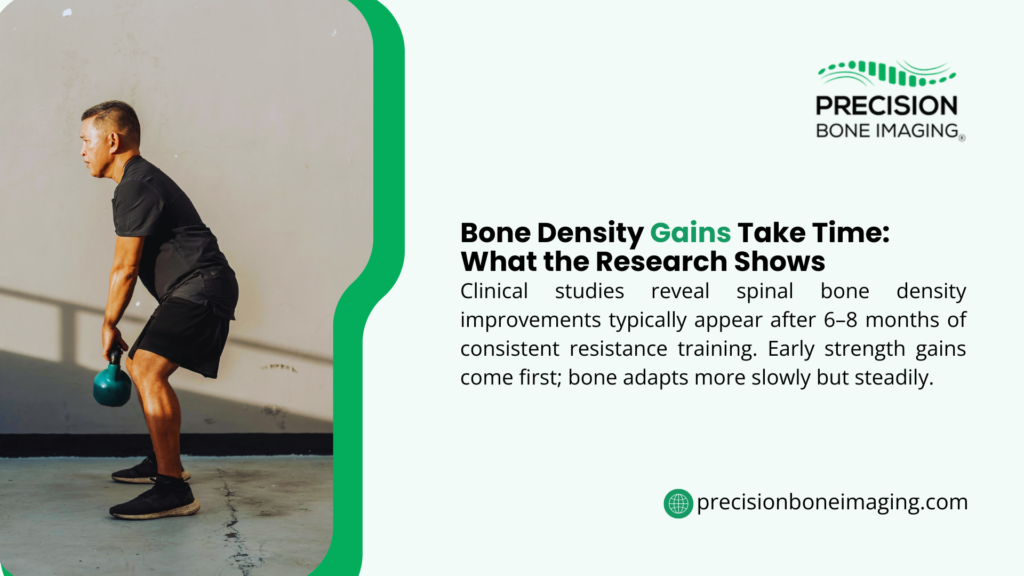
A major meta-analysis demonstrated that a period of 6-8 months of uninterrupted resistance training regimen in postmenopausal women resulted in an increase of about 1-2% in their lumbar spine bone density.
The advantages do not stop at the bone density level. The muscles of the back and core that are strong enough to withstand injury will also support, improve, and reduce the pain of the spine.
Exercises like bird dog and planks, which increase balance, will not only give you the added advantage of falling but will also prevent you from being part of the majority of older adults who suffer hip fractures due to falling.
REMS Technology VS Traditional DXA
Building strong bones through exercise is just one part of your longevity foundation.
To know if your efforts are working, you need precise insights into both bone density and bone quality.
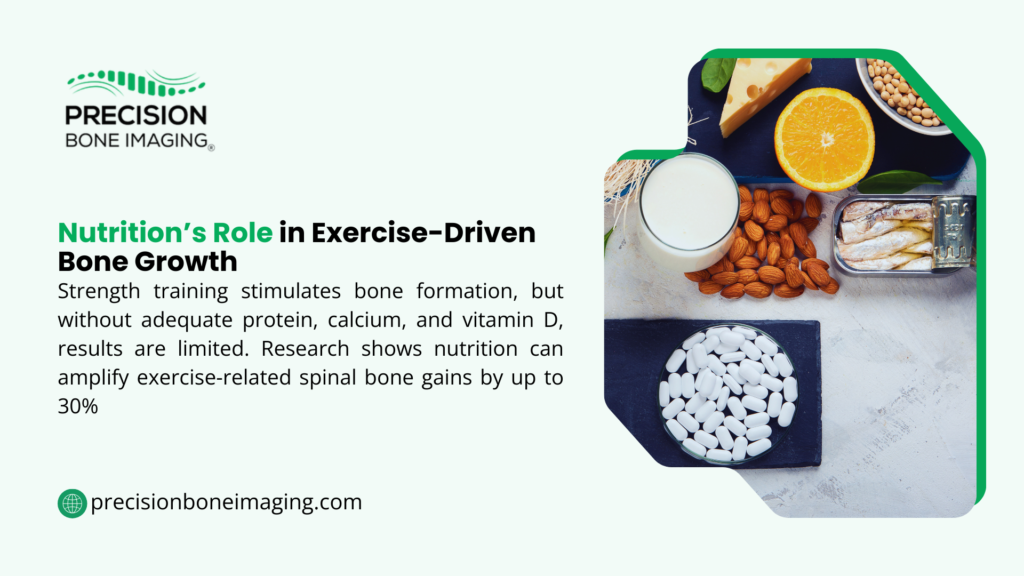
Traditional DXA scans only measure density, but REMS technology provides up to 30% more accurate fracture risk assessment by analyzing bone quality and strength.
This precision matters because two people can have the same density score but vastly different fracture risks based on bone quality.
Regular monitoring gives you the clarity and confidence to adjust your exercise program, nutrition, and lifestyle choices based on real data.
What you measure gets managed and tracking your progress every 6-12 months shows you exactly how your bones are responding to your efforts.
When to Seek Professional Guidance
If you have low bone density, or previous bone injuries, consult with a physical therapist or qualified exercise professional before starting a new program.
They can assess your current strength, balance, and flexibility, then design a safe progression that meets your specific needs.
Working with a physical therapist helps you identify which exercises are right for your current strength level, ensuring you build bone safely and effectively from wherever you’re starting.
Professionals also ensure you learn proper form, which maximizes the bone-building benefits while minimizing injury risk. Even one or two sessions can provide valuable feedback about your technique.
Track Your Progress with Precision Imaging
The exercises that increase bone density in the spine work, but you need accurate measurements to track your progress and know if your program is effective.
Precision Bone Imaging uses advanced REMS (Radiation-Free Echographic Multi-Sensor) technology to measure both bone density and bone quality in your spine without any radiation exposure.
Unlike traditional DXA scans, REMS provides instant, comprehensive results that show exactly how your bones are responding to exercise and other dexa scan alternative approaches.
Over 2,400 people have chosen our radiation-free approach because it’s safe to scan as often as needed while you work to strengthen your bones.
Book your bone scan with Precision Bone Imaging today to establish your baseline and track your improvement over time. Early detection and regular monitoring give you the best chance to prevent fractures and maintain strong bones for life.
Important Note:
This information is for educational purposes only and does not replace medical care. Always consult with your healthcare provider before starting a new exercise program, especially if you have existing bone health concerns.