
Caffeine and bone loss research has produced conflicting headlines for years, leaving many people unsure whether they should cut back or keep enjoying their daily cup.
Millions of adults drink caffeine every day, and low bone mineral density already affects a large share of adults over 50, which makes this topic worth understanding clearly rather than guessing about.
This article explains what current research on caffeine and bone loss actually says, covers who may need to pay closer attention, and shares practical ways to support bone health without unnecessary restriction.
Caffeine and Bone Loss: What the Research Says in Short
Moderate caffeine intake, generally 400 milligrams or less daily, appears unlikely to meaningfully harm bone health in most healthy adults.
A meta-analysis of 14 observational studies covering more than 562,000 participants found coffee consumption was significantly associated with a reduced risk of osteoporosis, which runs counter to the assumption that coffee is a bone health liability.
That said, certain groups carry higher sensitivity, and lifestyle factors matter considerably more than caffeine intake alone.
Someone with strong calcium intake and regular bone-supportive exercise, including appropriate impact activity, resistance training, and Osteogenic Loading, experiences caffeine very differently than someone already managing low bone density or a family history of osteoporosis.
Key Takeaway: Current evidence suggests caffeine and bone loss are only one small piece of a much larger puzzle. Diet, exercise, age, hormones, and overall nutrition carry far more influence on long-term bone health than a coffee habit alone.
| Research Question | Current Evidence |
| Does caffeine reduce calcium absorption? | Yes, but the effect is small |
| Does moderate coffee cause osteoporosis? | Evidence does not consistently support this |
| Can excessive intake increase risk? | Possibly, for certain higher-risk groups |
| Are lifestyle habits more important than caffeine? | Yes, considerably |
How Does Caffeine Affect Bone Health?
If caffeine does not directly weaken bones for most people, why has this topic been studied for decades?
The answer lives inside a few specific biological mechanisms, and understanding them clarifies why real-world evidence looks more reassuring than early lab findings once suggested.
Bone health depends on a cycle called remodeling. Osteoblasts build new bone tissue, and osteoclasts break old bone down so it can be replaced.
In a healthy adult, these processes stay balanced. Caffeine’s effects on this system are real but modest, and they mostly involve calcium rather than the remodeling cycle itself.
Caffeine interferes with calcium in two specific ways:
- Reduced intestinal absorption: Caffeine slightly lowers how efficiently your intestines pull calcium from food, an effect that shows up consistently in controlled studies
- Increased urinary excretion: Caffeine also raises how much calcium your kidneys release through urine, pulling a small additional amount away from the pool your bones depend on
Researchers originally became concerned because these two mechanisms are measurable and consistent in lab settings. What complicates the picture is that measurable does not always mean meaningful.
Does Caffeine and Bone Loss Come Down to Calcium Absorption?
Yes, caffeine and bone loss come down to calcium absorption, but the effect is small enough that most people never notice a practical difference.
In a controlled calcium-balance study, each six-ounce serving of caffeinated coffee shifted calcium balance approximately 4.6 milligrams in the negative direction.
Adequate calcium intake, whether from food or from adding milk to your coffee, easily offsets this small effect for most healthy adults. The concern grows only when calcium intake is already low or when several risk factors overlap at once.
What Does the Latest Research Say About Caffeine and Bone Loss?
Rather than listing individual studies one by one, it helps to look at how the overall evidence on caffeine and bone loss has shifted over time. Older research raised real concerns, while newer, larger studies paint a considerably more reassuring picture for most adults.
Earlier Studies That Raised Concerns
Some of the earliest research linking caffeine to bone loss came from small studies involving older postmenopausal women with relatively low calcium intake.
These studies found associations between higher caffeine consumption and lower bone density, which shaped public perception for years.
The limitation researchers now recognize is that many of these women were also consuming less calcium overall, making it difficult to separate caffeine’s effect from a broader nutritional gap.
Research Snapshot: Early findings shaped public concern, but later analysis revealed calcium intake, not caffeine alone, likely drove much of the observed effect.
What Newer Research Tells Us
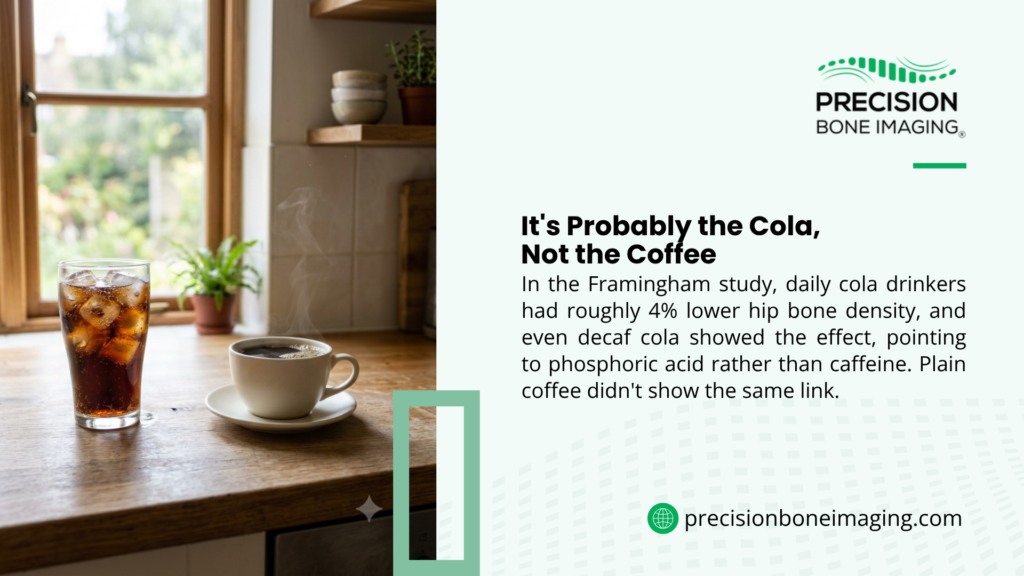
A 2025 ten-year longitudinal study tracking coffee and tea consumption alongside bone mineral density in older women added further nuance, since most earlier research relied on single-timepoint measurements rather than tracking the same women over time.
Women who drank tea showed slightly higher total hip bone density than non-tea-drinkers, a small but statistically significant difference.
Researchers suggested that catechins in tea may help explain the association, because these compounds have been linked in earlier research to bone formation and slower bone breakdown. The effect was described as modest but potentially meaningful across a large population.
Coffee: The findings here were more nuanced than a simple yes/no.
- Moderate intake, roughly two to three cups daily, showed no association with harm
- Exceeding five cups daily was linked to measurably lower bone density
- Women with higher lifetime alcohol intake appeared especially vulnerable to coffee’s negative effects at high doses, suggesting the two habits compound each other
One of the researchers, Ryan Liu, noted that coffee’s caffeine content has been shown in lab studies to interfere with calcium absorption and bone metabolism:
“Coffee’s caffeine content, by contrast, has been shown in laboratory studies to interfere with calcium absorption and bone metabolism, though these effects are small and can be offset by adding milk.”
Because the study used repeated measures over 10 years, it adds useful long-term context beyond earlier single-timepoint research.
Research Snapshot: Newer, larger, and longer studies consistently show a more neutral to favorable relationship between moderate coffee intake and bone health than older research suggested.
| Earlier Understanding | Current Understanding |
| Caffeine directly causes bone loss | Caffeine’s calcium effect is small and easily offset |
| Any coffee intake raises osteoporosis risk | Moderate intake shows neutral to favorable associations |
| All studies show consistent harm | Findings vary by population, dose, and calcium intake |
Who Should Pay the Most Attention to Caffeine Intake?
The answer to who should worry about caffeine and bone loss is not the same for every reader, since baseline risk and calcium intake both shape how much caffeine actually matters for an individual.
Women in Perimenopause, Postmenopause, and Older Adults
This group carries the highest sensitivity to caffeine’s effects, largely because bone loss can accelerate during perimenopause and early postmenopause as hormone patterns change, independent of diet.
One study found postmenopausal women with a specific vitamin D receptor gene variant experienced significantly higher rates of spinal bone loss than women with a different variant, when caffeine intake exceeded 300 milligrams daily.
This illustrates why genetics can shift how caffeine interacts with bone health, even though the effect for most women remains modest at typical intake levels.
Adequate calcium and vitamin D intake become especially important for this group, since both nutrients help counteract the small absorption effect caffeine produces.
People With Osteopenia or Low Bone Density
For readers already managing lower bone density, caffeine deserves attention as one factor among several rather than a primary concern.
Alcohol and bone density long term research shows a similar pattern, where lifestyle factors compound rather than acting in isolation, and the same logic applies here. Reducing caffeine sharply is rarely necessary.
Building a stronger overall foundation, through calcium, vitamin D, and bone-supportive loading such as appropriate impact exercise, resistance training, and Osteogenic Loading, matters considerably more than eliminating coffee.
Healthy Adults With Balanced Diets
For most healthy adults eating a reasonably balanced diet, moderate caffeine is unlikely to represent a meaningful concern. The research summarized above supports this directly, and there is little reason for this group to change established habits.
| Group | Relative Concern | Key Recommendation |
| Women in perimenopause, postmenopause, and older adults | Moderate to elevated | Prioritize calcium, vitamin D, and caffeine awareness as part of a broader bone-health plan |
| People with osteopenia or low bone density | Moderate | Focus on overall lifestyle and tracking, not caffeine elimination |
| Healthy adults with balanced diets | Low | Continue typical habits without unnecessary restriction |
Practical Tips for Enjoying Caffeine While Supporting Bone Health
Readers rarely need to eliminate coffee. Small, consistent habits protect bone health far more effectively than restriction alone.
Build Habits That Protect Your Bones
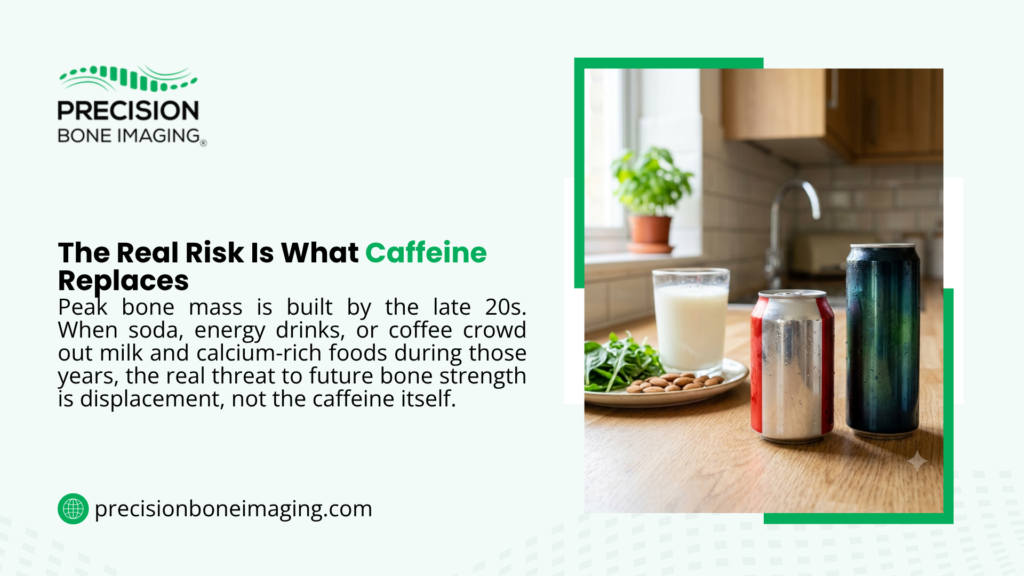
- Prioritize calcium-rich foods like dairy, leafy greens, sardines with bones, almonds, and fortified plant milks only when dairy is not well tolerated.
- Get adequate vitamin D through diet, sunlight, or supplementation, since it supports how efficiently your body uses calcium.
- Add one to two tablespoons of milk to your coffee if appropriate for your diet; a scientific review found that this amount can offset caffeine’s small effect on calcium absorption.
- Include regular bone-supportive loading, including appropriate impact exercise, resistance training, and Osteogenic Loading.
- Follow foods to prevent osteoporosis as a practical, food-first foundation rather than relying on supplements alone.
How Do DXA and REMS Compare When Checking Bone Density?
Once you understand how caffeine and bone loss connect, the next practical question is how you actually find out where your own bones stand. Two main technologies handle bone density checking today, and they work quite differently.
DXA, short for dual-energy X-ray absorptiometry, has been the standard bone density test for decades. It uses low-dose radiation to measure mineral content at the hip and spine, producing a T-score that compares your results to a healthy young adult baseline.
It’s widely available and well-studied, but it only measures density, not the internal structure of the bone itself, and the radiation exposure means providers generally limit how often you can repeat the scan.
REMS, or Radiofrequency Echographic Multi-Spectrometry, uses ultrasound instead of radiation, which means no ionizing radiation exposure and strong suitability for repeat tracking over time.
REMS also assesses bone density along with a Fragility Score related to skeletal fragility and characteristics associated with bone quality, giving a more complete picture of fracture risk than a density number alone.
| Feature | DXA | REMS |
| Radiation exposure | Low-dose X-ray | None |
| What it measures | Bone density only | Bone density plus Fragility Score related to skeletal fragility |
| Scan frequency | Limited due to radiation and 4-6% Least Significant Change | Supports repeat tracking, often every 6 to 12 months when appropriate |
| Affected by arthritis, scoliosis, or implants | Yes, can distort results | Not affected by these factors |
| Results timeline | Days to weeks | Immediately after the scan |
Understanding how to prevent osteoporosis begins with knowing where your bones stand today.
This assessment is for informational purposes only and does not replace medical care.
Frequently Asked Questions
Does caffeine actually cause bone loss?
For most healthy adults, consuming up to 400 milligrams of caffeine per day is unlikely to have a meaningful negative effect on bone health. Research on caffeine and bone loss shows a small, easily offset effect on calcium absorption rather than a direct cause of osteoporosis.
Can drinking coffee increase my risk of osteoporosis?
Current research does not support this for moderate intake. Several large meta-analyses have found coffee consumption associated with a reduced risk of osteoporosis rather than an increased one.
How much caffeine is considered safe for bone health?
Research generally points to 400 milligrams daily as a reasonable upper threshold, roughly three to four cups of coffee, beyond which some studies show a shift toward net bone loss.
Is tea better than coffee for protecting bones?
Some research suggests tea’s polyphenol content may offer modest bone benefits beyond its caffeine content, though the evidence is still developing and coffee has not been shown to meaningfully harm bone health at moderate intake.
Get Clarity on Your Bone Health Today
Understanding caffeine and bone loss research helps you separate genuine risk from outdated assumptions, but real clarity comes from knowing where your own bones stand rather than guessing based on your coffee habit.
Precision Bone Imaging has completed more than 4,800 radiation-free bone health assessments, using REMS technology that measures bone density and provides a Fragility Score related to skeletal fragility and characteristics associated with bone quality within a single session.
We provide:
- Radiation-free, instant scans that deliver same-day results without ionizing radiation.
- Clearer bone health insight through REMS technology, assessing bone density and skeletal fragility-related findings together rather than density alone.
- Instant printed and digital results paired with educational guidance, so you leave with direction, not just numbers.
- Educational guidance based on your assessment findings, supporting habits like calcium intake and bone-supportive loading with clearer data behind them.
If you are wondering when you should get a bone density test, especially as a woman managing perimenopause or menopause-related changes, a prevention-first schedule starts with a single baseline assessment.
Book your radiation-free bone health assessment today. Know your strength. Protect your future.
This assessment is for informational purposes only and does not replace medical care.