
We know lifestyle plays a big role in shaping overall health, daily routines, and long-term wellbeing. But when it comes to bone health, a bigger question remains: can lifestyle changes overcome genetic risk for osteoporosis, or are we mostly limited by what we inherit?
This article examines whether lifestyle changes can help manage the genetic risk for osteoporosis, breaks down what the science actually supports, and offers a clear framework for anyone who wants to take their bone health seriously.
Understanding Bone Health: Why Genetics Are Only the Starting Point
Nearly 70% of all osteoporosis cases in the United States go undiagnosed. Most people with weakening bones have no indication of it, until a fracture brings the reality forward.
Bone is not a fixed structure. It responds and adapts throughout life, shaped by what you eat, how you move, and the hormonal environment your body creates at different stages.
Genetics determine the baseline: your structural potential, your peak bone density, and how quickly you might naturally lose bone mass. What genetics do not determine is the final outcome.
| Factor Type | What It Influences |
| Genetics | Baseline bone structure and peak density |
| Lifestyle | Bone strength and density over time |
| Hormones | Bone turnover rate |
| Activity level | Bone stimulation and resilience |
Research from twin and family studies confirms that 60 to 70% of the variation in bone mineral density is linked to genetic factors. The remaining 30 to 40% reflects diet, movement, and daily habits, a share large enough to meaningfully shift your trajectory over a lifetime.
For a broader look at how family history affects risk, this resource on whether osteoporosis is genetic covers the full picture.
What Genetic Risk Really Means for Bone Health
A genetic predisposition does not make osteoporosis a certainty. What it means is that your starting point may be lower, and your rate of bone loss may be faster without active intervention.
The genetic risk for osteoporosis increases probability, not inevitability. What changes with this awareness is your capacity to act earlier, giving yourself time to build habits that protect bone health before significant loss begins.
Why Bone Health Changes Over Time
Bone tissue goes through a constant cycle of breakdown and renewal. After your early 30s, breakdown begins to outpace renewal — gradually, without symptoms.
Key factors that shape this process include:
- Physical activity and the mechanical load placed on bone
- Nutrient intake and how well the body absorbs key compounds
- Hormonal shifts, particularly estrogen and testosterone decline
- The natural pace of age-related change in bone tissue
Can Lifestyle Changes Overcome Genetic Risk for Osteoporosis?
If you cannot change your genes, how much can your daily habits actually change the outcome?
Lifestyle choices cannot alter your genetic code, but they can significantly influence how that genetic code expresses itself over decades.
A prospective cohort study from the UK Biobank found that people with high genetic risk who maintained healthy lifestyle habits had better bone outcomes than those with low genetic risk and poor habits.
In practical terms, strong habits outperformed favorable genetics.
| Scenario | Genetic Risk | Lifestyle Quality | Bone Outcome Trend |
| High risk + low activity | High | Poor | Faster decline |
| High risk + strong habits | High | Strong | Stabilized/optimized |
| Low risk + poor habits | Low | Poor | Unexpected decline |
This pattern appears consistently across large-scale research: lifestyle quality matters more than genetic risk level alone when it comes to long-term bone outcomes.
The Science Behind Bone Adaptation
Bone tissue responds to three primary inputs: mechanical stress, nutritional supply, and hormonal balance. When placed under controlled, progressive load through resistance work or weight-bearing movement, bone receives a signal to maintain and reinforce its structure.
Without that stimulus, the body has no reason to prioritize bone. Bones strengthen when challenged appropriately, and that principle holds regardless of your genetic profile.
For practical lifestyle steps that support bone mass, see how to prevent osteoporosis.
Why Genetics Don’t Act Alone
Gene expression does not happen in a vacuum. What you eat, how you move, and your hormonal health all influence how genetic predispositions play out over time.
Lifestyle acts as a modifier. Someone with a high genetic risk for osteoporosis who builds consistent habits effectively narrows the gap between their genetic potential and their actual bone outcome.
The biology supports this clearly, and the data from large-scale cohort studies reflects it.
The 4 Pillars of Strong Bone Health (What You Can Control)
Regardless of your genetic risk for osteoporosis, these four areas remain within your direct control. A clear framework here makes the difference between abstract knowledge and real action.
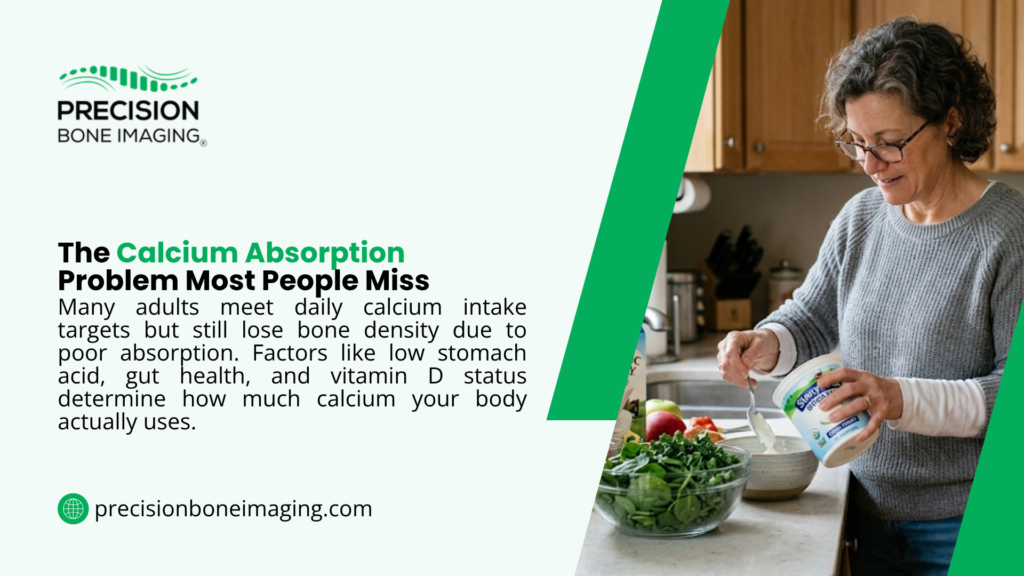
Nutrition That Supports Long-Term Bone Strength
Bones are metabolically active. They require consistent nutritional input to maintain their structure, and deficiencies in key nutrients accelerate bone loss over time.
| Nutrient | Role in Bone Health | Key Sources |
| Vitamin D | Essential for mineral absorption | Sunlight, fatty fish, fortified foods |
| Protein | Forms the structural matrix of bone | Eggs, legumes, lean meats, fish |
| Magnesium | Supports bone mineral metabolism | Nuts, seeds, dark leafy greens |
| Vitamin K2 | Directs minerals into bone tissue | Fermented foods, egg yolks |
A balanced dietary approach focused on whole foods and consistency matters more than short-term changes. For dietary strategies in depth, see foods to prevent osteoporosis.
Movement That Stimulates Bone Strength
Weight-bearing activity and resistance work are the most direct tools for bone stimulus. Bone responds to load, and without it, the remodeling cycle loses its primary signal.
Evidence-backed movement options include:
- Resistance work: squats, step-ups, deadlift variations, loaded carries
- Osteogenic Loading with special devices that simulate impact and trigger osteogenesis
- Jump training: 8-inch heel drops working up to larger drops when safe
A study of nurses found that those who walked four hours per week were 41% less likely to fracture a hip compared to those who walked less than one hour per week. That result came from consistency, with high-performance effort, significantly accelerating your result
Research on exercises that increase bone density in the spine consistently identifies compound lower-body and hip hinge movements as the most effective options for spinal bone strength.
Lifestyle Factors That Increase Bone Loss and Fracture Risk
Several common habits carry an underestimated effect on bone health over time:
- Smoking
For every 10-year increase in age, bone density in current smokers falls approximately 2% below that of non-smokers. A 1.0 standard deviation decrease in bone density doubles fracture risk, making long-term tobacco use a cumulative threat to bone strength.
- Alcohol
People who consume two or more drinks per day carry 1.63 times the risk of developing osteoporosis compared to non-drinkers. A large population analysis found that daily alcohol above one to two ounces raised hip fracture risk by 68%.
- Sedentary behavior
Extended periods without weight-bearing movement remove the mechanical signal bone needs to maintain its structure, even for people who exercise at other times of the day.
Why Bone Health Risk Is Often Misunderstood
Osteoporosis is widely called the “silent disease” for a reason. Bone loss produces no pain, no visible change, and no warning until a fracture occurs.
Research confirms that around 35% of people who fracture a bone are unaware that osteoporosis caused it, and more than half did not know that one osteoporotic fracture increases the risk of another.
The result is a significant gap between actual risk and personal awareness, one that affects even health-conscious adults who assume they are fine because they feel fine.
The Limitations of One-Time Health Checks
A single bone health snapshot captures a moment. It does not show the direction of change, the pace of bone loss, or whether current habits are effective.
Bone health requires observation over time. A 10% loss of bone mass in the hip results in a 2.5 times greater risk of hip fracture, a change that accumulates across years and goes undetected without follow-up assessment.
Why Early Awareness Changes Outcomes
Adults who gain bone health insight early have one key advantage: time to act before the trajectory becomes difficult to reverse.
Early awareness supports:
- More targeted nutrition decisions
- Purposeful exercise selection
- Informed choices about supplementation
- Clear benchmarks for progress over time
The difference between reactive and preventive care often comes down to a single step: knowing your baseline before a fracture makes it necessary.
Taking Control of Your Bone Health (A Practical Approach)
If you have a family history of osteoporosis, what should you actually do next?
A structured approach, aligned with both the science and practical reality, looks like this:
| Step | Focus | Why It Matters |
| Establish a baseline | Bone strength assessment | Provides a starting point for all future decisions |
| Optimize lifestyle | Nutrition, movement, daily habits | Reduces the expression of genetic risk over time |
| Gain bone health insight | Current density and quality | Reveals actual status, not assumed status |
| Track progress | Assessment every 6 to 12 months | Turns intention into measurable outcomes |
For adults who want to go deeper on practical steps, the guide on how to increase bone density covers the full range of strategies from nutrition to supplementation.
Why Assessment Matters for Clarity and Confidence
Lifestyle changes provide real benefits. But without assessment, they offer a partial picture. You improve without a clear starting point, and you progress without objective confirmation that your efforts are producing results.
Bone health assessment provides clarity on:
- Your current bone density and quality
- The direction of change over time
- Specific areas of risk or resilience
This is not about diagnosis. It is about insight — a roadmap you can act on, and the confidence that comes from knowing rather than assuming where your bone health stands.
For a direct comparison of assessment approaches, DXA vs REMS radiation explains what each method measures and how it affects the accuracy of what you receive.
Key Takeaway: Genetics Influence Risk, Lifestyle Shapes Your Path
Genetics set the baseline. They influence starting bone density, structural potential, and natural turnover rates. That is real, and it matters.
But the data is equally clear: lifestyle choices shape the actual outcome.
People with a high genetic risk for osteoporosis who build consistent habits consistently outperform those with low genetic risk and poor habits.
The gap between what your genes suggest and what your body actually does is determined largely by what you choose to do with that information.
Proactive steps matter. Awareness leads to better long-term bone health, whatever your starting point may be.
Frequently Asked Questions
How much do genetics vs. lifestyle affect bone health?
Studies estimate that 60 to 70% of the variation in bone mineral density is linked to genetic factors. The remaining 30 to 40% reflects lifestyle choices, including movement, nutrition, and daily habits.
That 30 to 40% is substantial enough to meaningfully shift bone health over a lifetime, even with a genetic risk for osteoporosis present.
What are the most effective lifestyle changes for bone density?
The highest-impact changes are consistent weight-bearing and resistance movement, adequate vitamin D and protein intake, reduced alcohol consumption, and avoidance of tobacco.
Consistency across all four areas produces far better results than excelling in one and neglecting others.
Can exercise actually rebuild bone, or just slow loss?
Both outcomes are possible. In postmenopausal women with low bone mass, resistance work at sufficient intensity has been shown to increase BMD at the spine and hip.
In older adults, slowing further loss is the more consistent result, but that still represents a meaningful shift in the right direction.
What type of exercise is best for bone strength?
Resistance work and weight-bearing activity have the strongest evidence. Squats, deadlift variations, step-ups, and loaded carries place direct mechanical load on the spine and hip, the sites most vulnerable to osteoporotic fracture.
Balance-based exercise adds a fall prevention layer that complements bone strength directly.
Take the Next Step for Your Bone Health
Genetic risk for osteoporosis is information, not a sentence. The earlier you know your bone health status, the more time you have to act with purpose.
Precision Bone Imaging provides radiation-free REMS bone health assessments at clinics in Los Angeles and Phoenix. Each session measures both bone density and bone quality — the two factors that together give you a complete picture of your bone strength.
Results are available the same day, in a clear format with actionable next steps. REMS technology is FDA-registered and CE-marked, delivering up to 30% more accurate fracture risk assessment than traditional DXA, with 40% greater sensitivity to changes in bone quality.
Zero radiation. No waiting. A clear path forward.
Book your radiation-free bone health assessment today and take control of the one factor your genetics cannot decide for you.
This assessment is for informational purposes only and does not replace medical care.