
Bone loss is one of the most common consequences of menopause, yet most women never see it coming. How menopause affects bone density is a question worth asking well before a fracture or scan result makes it urgent.
The Bone Health and Osteoporosis Foundation confirms that women can lose up to 20% of their bone density in the five to seven years after menopause. That window is short, and the shift is often already underway before anyone checks.
“1 in 2 women over the age of 50 will experience a bone fracture in their lifetime. Most have no warning signs beforehand.”
For practical steps you can take alongside this knowledge, see our guide on how to slow bone loss naturally after menopause.
How Menopause Affects Bone Density
The connection between menopause and bone health comes down to one hormone: estrogen. It acts as a natural regulator of bone remodeling, the continuous process through which old bone tissue is broken down and replaced with new bone.
When estrogen levels fall sharply at menopause, this balance is disrupted. Bone breakdown begins to outpace bone formation, and bone mineral density starts to decline at a pace that was not present before.
| Menopause Stage | Hormonal Change | Effect on Bone |
| Perimenopause | Estrogen begins to fluctuate | Bone loss may begin to accelerate |
| Early postmenopause | Sharp drop in estrogen | Most rapid period of bone mineral loss |
| Late postmenopause | Sustained low estrogen | Continued slower but cumulative bone loss |
How Menopause Affects Bone Density: Why Estrogen Loss Matters
Estrogen supports bone health by slowing the activity of osteoclasts, the cells responsible for bone resorption. With less estrogen, osteoclast activity increases and bone tissue is broken down faster than the body can replace it.
This is not a gradual, decades-long change. For most women, the sharpest decline happens in the first years after menopause, which is precisely why early awareness has real value.
How Fast Does Bone Density Drop After Menopause?
Bone loss is fastest in the early postmenopausal years and does not stop there. A 2026 StatPearls clinical review confirmed that between menopause and age 75, around 22% of total body bone mineral may be lost.
| Timeline | What Typically Happens to Bone |
| Before menopause | Bone remodeling stays relatively balanced |
| First 5 years after menopause | Fastest period of bone mineral loss |
| 5 to 15 years postmenopause | Loss slows but continues |
| Long-term | Cumulative decline raises fracture risk significantly |
Why Bone Loss Often Goes Unnoticed During Menopause
One of the most important facts about how menopause affects bone density is that the process is entirely silent. There is no pain, no stiffness, and no visible sign that bone tissue is changing beneath the surface.
Many women assume a fracture or obvious symptom would signal a problem long before it became serious. That assumption leads to late detection in a large percentage of cases, which is a pattern the evidence consistently confirms.
Can Menopause Bone Loss Happen Without Symptoms?
Yes. Bone loss during and after menopause produces no reliable physical warning signs. A 2026 analysis confirmed that nearly 69% of all osteoporosis cases in the United States remain undiagnosed.
For many women, the first sign is a fracture that occurs with minimal force, which is already an advanced stage of bone loss.
| Common Assumption | What the Evidence Shows |
| “I would feel bone loss happening” | Bone loss is typically painless and leaves no early signals |
| “I’m too young to need a scan” | Rapid loss can begin in the early 40s and 50s |
| “A fracture would need a serious fall” | Fragility fractures can occur from minimal impact |
| “My doctor would flag it automatically” | Screening often depends on a proactive risk conversation |
What Warning Signs May Suggest Higher Risk?
While bone loss itself has no symptoms, certain circumstances raise the probability of faster or earlier decline. These are not symptoms to diagnose, but signals worth discussing with a clinician:
- A height loss of one centimeter or more over time
- A fracture from a low-impact event, such as a minor fall or a bump
- A close family member who fractured a hip or spine after age 50
- Early menopause before age 45
- Long-term use of corticosteroid medications
Who Is Most at Risk of Faster Bone Loss
How menopause affects bone density varies from person to person. Several factors can accelerate the rate of loss during and after the menopausal transition, and many of them interact rather than act in isolation.
| Risk Factor | Why It Matters | Next Step |
| Early menopause (before 45) | Longer window of estrogen deficiency | Consider earlier assessment |
| Family history of fractures | Independent genetic contribution to bone risk | Discuss screening timing with clinician |
| Long-term corticosteroid use | Directly reduces bone mineral density | Review with prescribing clinician |
| Low body weight | Less mechanical load on bone; lower estrogen reserves | Prioritize weight-bearing activity |
| Cigarette use | Reduces estrogen and impairs bone formation | Cessation reduces cumulative risk |
| Sedentary lifestyle | Removes physical stimulus bone needs to stay strong | Introduce resistance and weight-bearing activity |
Early Menopause, Family History, and Low Estrogen Exposure
Women who experience menopause before age 45 face a longer period of low estrogen, which means earlier onset of bone loss and a more extended window of cumulative risk.
A family history of osteoporosis or hip fractures also raises baseline risk independently of lifestyle choices.
Lifestyle and Medication Factors That Can Compound the Risk
Risk does not come from one factor alone. Smoking, low physical activity, inadequate calcium and vitamin D intake, low body weight, and certain medications each contribute to faster bone loss.
When several of these factors are present together, the combined effect is greater than any single factor on its own.
Why Active Women and Athletes Still Need Bone Health Attention
Physical activity supports bone density, but it does not override hormonal risk. Active women who reach menopause face the same estrogen-related decline as those who are sedentary.
Fitness reduces some fracture risk factors, but it does not eliminate the need for regular bone health assessment after menopause.
How to Check Bone Health and Understand Results
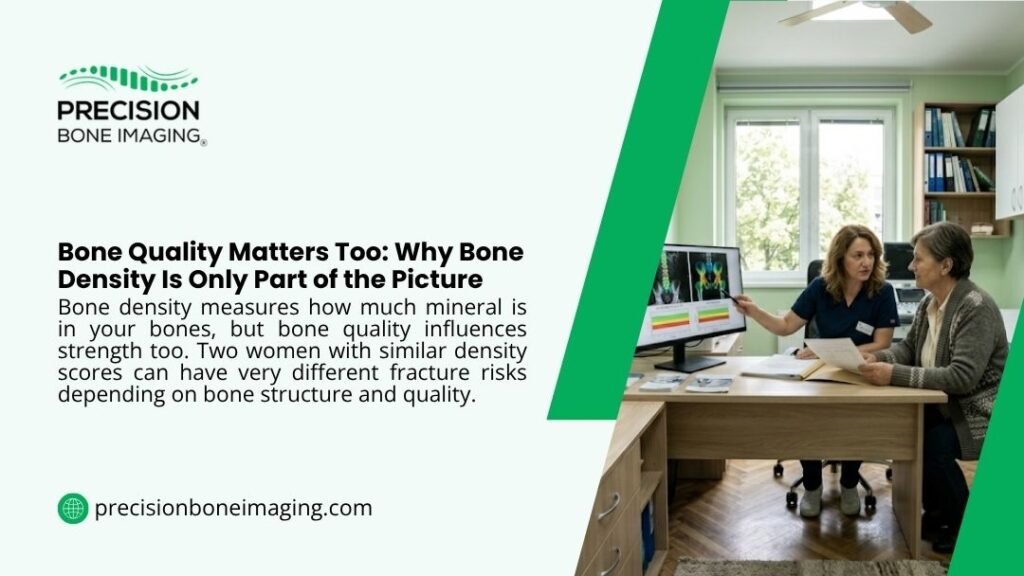
For many women, a bone health assessment provides the clearest answer to how menopause affects bone density in their specific situation. It converts general risk awareness into personal, measurable data.
In 2025, the U.S. Preventive Services Task Force updated its guidelines to include a Grade B recommendation for osteoporosis screening in women under 65 with one or more risk factors. Earlier screening is now formally supported for higher-risk women, not just those over 65.
For a broader overview of evidence-based prevention, see how to prevent osteoporosis.
When Should You Ask for a Bone Density Assessment?
Routine screening is recommended at age 65. For women with risk factors, current evidence supports earlier assessment.
Risk factors such as early menopause, low body weight, family history, or prior fractures are each sufficient reason to begin this conversation sooner rather than later.
From a clinical standpoint, the question is rarely “is it too early to check?” It is more often “why did no one check sooner?”
What Do T-Scores and Low Bone Density Results Mean?
A bone density assessment returns a T-score, which compares your bone mineral density to the average for a healthy young adult. The World Health Organization uses three standard classifications:
| T-Score Range | Classification | What It Means |
| -1.0 or above | Normal | Bone density is in a healthy range |
| -1.0 to -2.49 | Osteopenia | Bone density is lower than average |
| -2.5 or below | Osteoporosis range | Significant bone loss; higher fracture risk |
Osteopenia does not automatically become osteoporosis, especially when identified early and addressed with consistent lifestyle action.
What Happens After a Low Result?
A lower-than-expected result is a starting point, not a final answer. It gives you a clear foundation to build a specific plan from, with a measurable reference point for follow-up.
The focus shifts from general prevention to a targeted approach based on your actual bone density and quality data.
What Helps Protect Bone Density After Menopause
Once you understand how menopause affects bone density, the focus shifts to protection. Several strategies carry strong, consistent research support for postmenopausal women.
| Action Step | Bone-Specific Benefit |
| Resistance exercise 2 to 3 times per week | Builds bone through direct mechanical load |
| Brisk walks, stair climbs, hiking | Stimulates bone-forming cells through weight-bearing activity |
| Adequate calcium and vitamin D | Supplies the mineral foundation bone tissue requires |
| Sufficient protein | Supports the structural matrix bone mineral attaches to |
| Regular bone health assessment | Confirms whether current efforts produce measurable results |
Which Types of Exercise Support Bone Health Best?
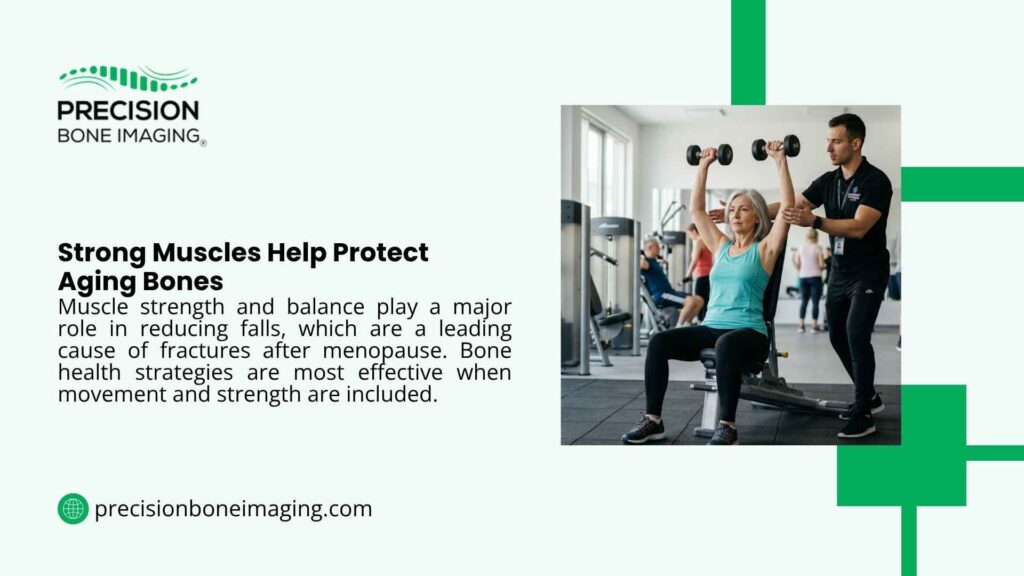
Resistance exercise and weight-bearing activity are the two categories with the strongest bone-specific evidence.
A 2025 meta-analysis in the Journal of Orthopaedic Surgery and Research, drawn from 690 participants, confirmed that resistance exercise significantly improved bone mineral density at the lumbar spine and femoral neck in postmenopausal women.
Recommended movement types:
- Resistance exercise two to three sessions per week at moderate to high effort
- Brisk walks, stair climbs, and dance for weight-bearing benefit
- Balance and coordination work to reduce fall risk
Nutrition, Protein, Calcium, and Vitamin D
Nutrients provide the raw material bone tissue depends on, but they work best alongside physical activity. Calcium alone is not enough.
Vitamin D, protein, and magnesium each play distinct roles that cannot be covered by any single supplement.
For a practical food-by-food guide, see foods to prevent osteoporosis.
Where Medical Options Fit in the Conversation
Hormone therapy and other clinician-guided approaches may be part of the bone health conversation for some women, particularly those with early menopause or multiple risk factors.
These decisions depend on individual health profile and personal preference. A clinician is the right guide for this part of the plan.
Frequently Asked Questions
How fast does bone density drop after menopause?
The sharpest decline typically occurs in the first five years after menopause. A 2026 StatPearls review confirmed that around 22% of total body bone mineral may be lost between menopause and age 75.
Can you lose bone density without any symptoms?
Yes, bone loss is entirely silent. There is no pain, no visible change, and no early physical signal. Nearly 69% of osteoporosis cases in the United States remain undiagnosed until a scan or fracture reveals the extent of the loss.
What is the difference between osteopenia and osteoporosis?
Osteopenia means bone density is lower than the young adult average, with a T-score between -1.0 and -2.49. Osteoporosis means more significant bone loss, with a T-score at or below -2.5. Both are measurable, and both respond to consistent lifestyle action when identified early.
When should a woman get her bones checked after menopause?
Routine screening is recommended at age 65. Women with risk factors such as early menopause, low body weight, or family history should ask about earlier assessment. The 2025 USPSTF update provides formal support for screening at-risk women under 65.
Bone Health After Menopause Starts With Clarity
How menopause affects bone density is not a question most women think about until a scan result or fracture makes it unavoidable. The evidence points consistently in one direction: the most effective window to act is before problems develop, not after.
A bone health assessment gives you a real baseline. A consistent plan gives you direction. And regular follow-up tells you whether your efforts are producing measurable results.
Take the Next Step With Precision Bone Imaging
Precision Bone Imaging provides radiation-free REMS bone health assessments in Los Angeles, Phoenix, and a nationwide expansion in 2026.
Every session delivers same-day findings on both bone density and bone quality, with clear guidance on what your results mean and where to focus your efforts next.
REMS technology at Precision Bone Imaging is FDA-registered, CE-marked, and validated to offer:
- Zero radiation exposure, safe for frequent and repeat assessments
- Instant results available the same day
- Complete bone density and quality data in one session
- No interference from arthritis, scoliosis, or metal implants
- Up to 30% more accurate fracture risk assessment than traditional DXA
- 40% greater sensitivity to changes in bone quality
Book your radiation-free bone health assessment today. Know your strength. Protect your future.
This assessment is for informational purposes only and does not replace medical care.