
Protecting bones during perimenopause is one of the most consequential steps a woman can take for long-term health and independence.
The changes happening internally during this stage are faster and quieter than general awareness reflects, and the window for prevention is shorter than it appears.
This guide covers why bone loss accelerates during this stage, which habits carry the strongest evidence, and how a radiation-free bone health assessment provides the clarity to act with confidence.
Protecting Bones During Perimenopause: Why This Stage Matters
The relationship between perimenopause and bone loss is more direct and more urgent than most people expect.
Bone loss during the menopausal transition does not follow a slow, predictable path. It accelerates sharply during late perimenopause, often before the final menstrual period, and the hip and spine bear the heaviest impact.
The loss that occurs during this three-year late perimenopausal window is greater than what typically follows in the postmenopausal years afterward. That single fact changes how early the conversation about bone health needs to start.
| Stage | Key Bone Change | Primary Focus |
| Early perimenopause | Gradual bone loss begins | Build bone-supportive habits and consider a baseline assessment |
| Late perimenopause | The rate of bone loss may accelerate | Pay closer attention to assessment, nutrition, and skeletal loading |
| Postmenopause | Bone loss continues at a slower pace | Maintain supportive habits and monitor changes over time |
Why Estrogen Changes Affect Bone Remodeling
Estrogen helps regulate bone remodeling, the continuous process in which older bone tissue is removed and replaced with new tissue. As estrogen levels fluctuate and decline during perimenopause, bone breakdown can begin to outpace bone formation. This helps explain why meaningful bone loss may occur before the final menstrual period.
Establishing a baseline during this transition can make future changes easier to monitor. Menopausal hormone therapy may help protect bone health for some women, but its suitability depends on individual symptoms, risks, health history, and treatment goals. Discuss hormonal health and available options with a qualified healthcare professional.
Around 1 in 4 women may experience a particularly rapid decline during this transition. Without proactive support, this group can face a significantly higher risk of osteoporosis later in life.
Although perimenopause is a critical monitoring period, bone-health awareness can begin much earlier. Most people reach peak bone mass around age 30, making early adulthood a valuable time to document their strongest baseline, particularly when risk factors are already present.
The Habits That Help Support Stronger Bones
Protecting bones during perimenopause comes down to four clear areas:
- Bone-specific movement that includes progressive resistance training, appropriate impact training, and Osteogenic Loading.
- Food-first nutrition that provides sufficient protein, calcium, vitamin D, and other supportive nutrients.
- Lifestyle choices that directly affect bone resorption.
- Regular assessment to determine whether the approach is producing measurable changes.
Each area supports the others. No single intervention replaces a complete bone-health strategy.
| Habit | Why It Matters | Simple Starting Point |
| Progressive resistance training | Muscle pulling against bone provides an important remodeling stimulus | Begin with two appropriately challenging strength sessions each week |
| Appropriate impact training | Short, higher-impact forces can stimulate bone at the hips and spine | Add safe jumping, hopping, or similar movements when appropriate for your ability and fracture risk |
| Osteogenic Loading | Provides a brief, targeted skeletal-loading stimulus designed to exceed the forces created by many everyday activities | Explore a professionally supervised Osteogenic Loading program |
| Calcium and vitamin D from food | Provide essential minerals and absorption support | Include dairy, leafy greens, fortified foods, eggs, or fatty fish regularly |
| Adequate protein | Supports the collagen-rich bone matrix, muscle mass, and physical strength | Aim for approximately 0.8–1.0 grams per pound of ideal body weight, adjusted for individual needs and professional guidance. |
| Reduce smoking and excess alcohol | Both accelerate bone resorption | Address the most reachable habit first |
Build a Complete Bone-Loading Routine
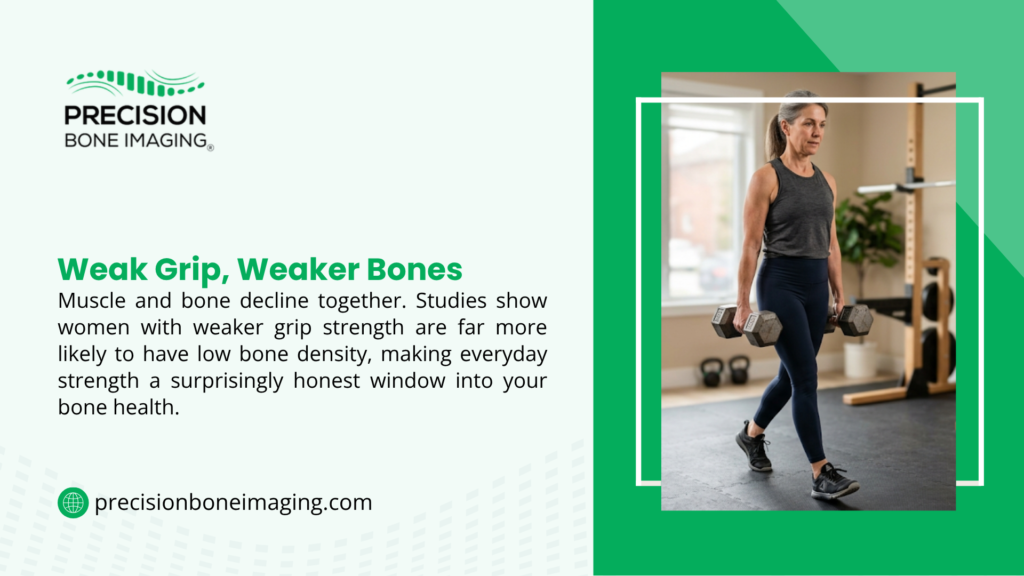
Bone formation at the spine and hip responds to mechanical demand. The more appropriately a movement challenges those sites, the stronger the adaptive signal may be.
Knowing what exercises increase bone density in the spine is more useful than simply knowing exercise is good for bone health. It helps you choose movements that provide a meaningful stimulus rather than relying only on low-intensity activity.
A complete bone-supportive routine should not stop at walking or general exercise. Progressive resistance training strengthens the muscles that pull on bone, appropriate impact training exposes the skeleton to short bursts of force, and Osteogenic Loading provides another targeted way to stimulate bone.
The right combination depends on current bone-health findings, balance, exercise experience, fracture history, and other medical considerations. Someone with a prior fragility fracture or significant osteoporosis findings should seek professional guidance before beginning high-impact or high-load exercises.
Nutrition First, Supplements Second
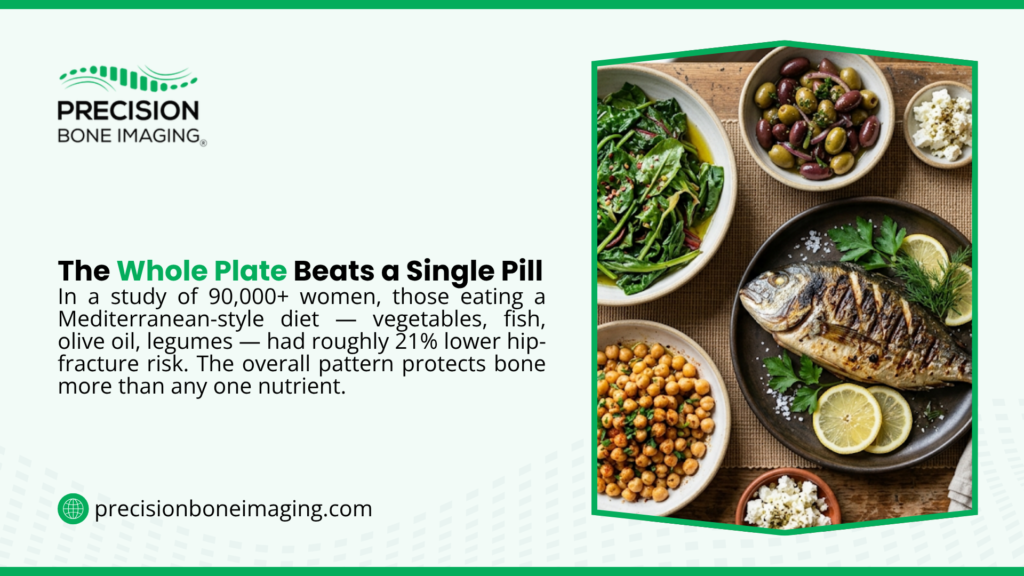
Food sources of calcium and vitamin D form the foundation before supplementation becomes relevant. Dairy, sardines, leafy greens, and fatty fish deliver these nutrients alongside co-factors that isolated supplements do not fully replicate.
The research is consistent on one point: exercise and nutrition reinforce each other for bone health. Combining both produces better results than either alone. Taking calcium without consistent movement is a partial solution at best.
| Nutrient | Top Food Sources | When Additional Support May Be Discussed |
| Calcium | Dairy, sardines, kale, fortified foods | Dietary intake consistently below 1,000 mg/day |
| Vitamin D | Fatty fish, eggs, sunlight | Limited sun exposure or northern climate |
| Vitamin K | Leafy greens and fermented foods | When dietary intake is consistently limited or professional guidance identifies a need |
| Magnesium | Nuts, seeds, legumes, leafy greens, and whole grains | When dietary intake or laboratory findings indicate a possible gap |
| Protein | Fish, poultry, eggs, dairy, lean meat, legumes, tofu, and protein products | When normal meals do not provide approximately 0.8–1.0 grams per pound of ideal body weight |
Supplement choices should account for diet, health history, laboratory findings, and current medications. They should support an individualized plan rather than replace food, exercise, or appropriate medical care.
Everyday Habits That Can Weaken Bone Support
Some habits affect bone health without obvious early signals. Three worth knowing:
- Smokers lose cortical bone at a faster rate than non-smokers, and women who smoke often reach menopause earlier, extending the overall period of accelerated loss.
- Chronic alcohol use slows osteoblast activity, the cellular process responsible for new bone formation.
- Both habits together compound the risk more than either does alone.
Small, consistent adjustments here carry more long-term benefit than short-term efforts elsewhere.
How a Bone Health Assessment Can Add Clarity
Good habits build the foundation. A bone health assessment shows where that foundation currently stands.
Protecting bones during perimenopause is more meaningful when daily effort is paired with measurable findings. Without a baseline, it is difficult to determine whether bone health is stable, declining, or responding to changes over time.
| What Habits Provide | What an Assessment Adds | Why Both Work Together |
| Reduced lifestyle risk | A measurable baseline for density and quality | Future changes can be documented |
| Consistent daily effort | Insight into current skeletal health | Decisions are informed by findings rather than assumptions |
| Nutrition and loading strategies | A point of comparison for future assessments | Progress can be monitored over time |
What a Radiation-Free Bone Health Assessment Helps You See
Bone mineral density is an important part of the picture. Bone quality, the characteristics of bone tissue that contribute to its resistance to fracture, provides additional information that density alone cannot fully capture.
REMS technology, available through Precision Bone Imaging, uses ultrasound to assess bone mineral density and generate a Fragility Score related to bone quality. It also provides a five-year fracture-risk assessment without exposing the client to ionizing radiation.
Results are available during the same visit in a color-coded report, accompanied by educational guidance that helps clients understand the measurements and prepare questions for their healthcare providers.
Why Tracking Progress Matters Over Time
A single assessment provides a starting point. Follow-up assessments can show whether findings remain stable or change after adjustments to nutrition, exercise, supplements, hormones, or other elements of a bone-health plan.
PBI commonly recommends reassessment after approximately six months during an active bone-health program and annual monitoring in other circumstances. The most appropriate interval should reflect the individual’s findings, risk factors, goals, and professional guidance.
Because REMS does not use ionizing radiation, it can support more frequent monitoring when that schedule is appropriate. What gets measured can be managed.
When to Pay Closer Attention and Ask for Guidance
Protecting bones during perimenopause takes on added urgency when specific risk factors are present. Some people have clear clinical grounds for acting earlier than standard timelines suggest.
| Risk Factor | Why It Raises Concern | Suggested Next Step |
| Family history of osteoporosis or hip fracture | Family history can provide risk information beyond current bone density | Consider establishing a baseline before or during perimenopause |
| Early or rapidly progressing perimenopause | Earlier hormonal changes may lengthen the period of accelerated bone loss | Discuss earlier assessment with a qualified healthcare professional |
| Low body weight | Lower body weight is a recognized risk factor for low bone mass | Review assessment timing and nutritional intake |
| Long-term corticosteroid use | Corticosteroids can affect bone formation and mineral metabolism | Discuss prompt assessment with a healthcare professional |
| Previous low-impact fracture | May indicate underlying skeletal fragility | Seek timely assessment and medical evaluation |
| Restricted eating or low energy availability | Can impair bone development and maintenance | Review nutrition, menstrual health, and assessment needs |
| Hormone-blocking cancer therapy | Some therapies can accelerate bone loss | Discuss baseline and follow-up monitoring with the treating clinician |
Do I Need to Wait to Think About Bone Health?
Women with factors such as a family history of osteoporosis, early hormonal changes, low body weight, previous low-impact fractures, or long-term corticosteroid use may benefit from discussing earlier assessment with a qualified healthcare professional. Prevention carries the most impact before bone loss reaches its fastest pace.
Who May Benefit from Earlier Attention
For adults with a family history of osteoporosis or a previous low-impact fracture, the question of when to get a bone density test has a different answer than it does for someone without recognized risk factors.
The aim is not simply to test as early as possible. It is to establish meaningful information before preventable changes have progressed unnoticed.
Common Misconceptions About Bone Health During Perimenopause
Part of protecting bones during perimenopause effectively is clearing up the beliefs most likely to lead people in the wrong direction. Many women do most of the right things and still feel uncertain, because common advice is often incomplete rather than wrong.
| Myth | Fact |
| Calcium alone is enough | Calcium without exercise and vitamin D produces limited results at most bone sites |
| Bone loss only matters after menopause | The fastest rate of loss typically occurs before menopause is complete |
| Walking fully protects bones | Walking supports general health, but a complete skeletal-loading plan should also consider progressive resistance training, appropriate impact training, and Osteogenic Loading |
| Act only when there is already a problem | Proactive habits and assessment are most useful before substantial bone loss or a fracture makes the problem visible. |
Bone Health Is About More Than One Supplement
No single supplement can reproduce the combined effects of appropriate skeletal loading, sufficient protein, food-first nutrition, hormonal awareness, and periodic assessment.
Strong bones are supported through a coordinated approach that includes resistance training, safe impact work, Osteogenic Loading, adequate nutrition, supportive lifestyle habits, and meaningful progress tracking.
FAQs
How can I protect my bones during perimenopause?
Build a complete strategy that includes progressive resistance training, appropriate impact exercise, Osteogenic Loading, food-first calcium and vitamin D, and approximately 0.8–1.0 grams of protein per pound of ideal body weight. Establishing a baseline assessment can then help you track whether your findings change over time.
When should I start paying attention to bone health?
Bone-health awareness can begin well before menopause. Peak bone mass is generally reached around age 30, which can be a useful time to understand your strongest baseline. For women who have not been assessed earlier, perimenopause is an especially important time to establish that baseline because bone loss can accelerate before the final menstrual period.
Is walking enough to support bone strength?
Walking supports cardiovascular health, balance, and general mobility, but it may not create enough skeletal stimulus on its own. A more complete program can include progressive resistance training, appropriately selected impact movements, and Osteogenic Loading.
Can a bone assessment help me understand my risk better?
Yes. A REMS assessment provides findings related to bone mineral density, bone quality, and five-year fracture risk. These findings can provide additional context for a conversation with your healthcare provider but do not independently diagnose or predict an individual outcome.
Do I need to wait until menopause to think about this?
No, protecting bones during perimenopause is most effective before bone loss reaches its fastest rate. This transition period is one of the most important windows in a woman’s bone health timeline.
Your Bone Health Deserves More Than a Number
Traditional bone-density scans primarily measure bone mineral density. REMS adds information related to bone quality and five-year fracture risk, providing a broader view of skeletal health in a radiation-free session.
At Precision Bone Imaging, bone health is the foundation of longevity. That belief shapes everything about how assessments are delivered.
We have completed more than 4,500 radiation-free assessments across more than 50 locations in major communities throughout the United States.
Our mission is to help people gain confidence about where their bone health stands today, and a clear path forward from there.
REMS uses FDA-cleared ultrasound technology and provides same-visit results without ionizing radiation. Its artifact-filtering approach is designed to reduce the influence of common issues that may complicate some DXA measurements, including osteoarthritis and certain structural changes.
Book your radiation-free bone health assessment today. Know your strength. Protect your future.
This assessment is for informational purposes only and does not replace medical care.